

Just because we are told we need a particular treatment does not necessarily mean we will choose to proceed. While this may not always appear rational to others, there are often personal, practical, financial, cultural, religious, and lifestyle considerations that influence our decisions. As individuals, we all have the right to weigh those factors according to our own values and circumstances.
When we are diagnosed with a condition, or suspect that we may have one, we may respond in different ways. Some people seek treatment immediately, some prefer to learn more before making a decision, and others may decide not to proceed at all. This is entirely their choice. One of the fundamental principles of modern healthcare is patient autonomy – the right of a competent individual to make informed decisions regarding their own care. The role of the clinician, whether physician, dentist, or other healthcare professional, is to explain the diagnosis, discuss the risks, benefits, alternatives, and likely outcomes, and support the patient in making the decision that is right for them.
We are all familiar with situations where individuals decline a blood transfusion because of personal or religious beliefs. Similar decisions occur every day throughout healthcare. Some people choose surgery, others decline it. Some accept medication, while others prefer lifestyle approaches. There is rarely a single reason behind a decision, and everyone’s thought process is different. In a free society, that is exactly how it should be. The important thing is that the decision is informed, considered, and made by the person who must ultimately live with the outcome.
So the clinician has a responsibility to his or her patient. They have one to their own profession and themselves too. The reasons may not be so obvious however … here are some considerations.

One of the fundamental principles of modern healthcare is patient autonomy. Simply put, this means that a competent individual has the right to make informed decisions regarding their own healthcare. The role of the clinician is not to make the decision for the patient, but to explain the diagnosis, discuss the risks, benefits, alternatives, and likely outcomes, and support the patient in making the decision that is right for them.
So the clinician has a responsibility to his or her patient. They also have a responsibility to their profession and to themselves. The reasons why people choose to proceed with, delay, or decline treatment are not always obvious, however. Here are some considerations.
MONEY
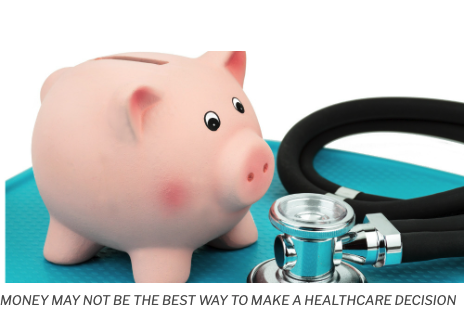
MONEY MAY NOT BE THE BEST WAY TO MAKE A HEALTHCARE DECISION
Most people would, without thinking, identify money as the number one hurdle to treatment. If money alone is the issue, however, there are generally ways around the problem if there is a genuine desire to proceed because of the benefit perceived by the individual.
Money is not quite the single issue it is often made out to be in healthcare. If the choice were between your life and your savings, what would you choose? Having said that, I have known people who have received medical estimates running into seven figures, so it would be misleading to suggest that cost is unimportant.
The problem for many is that the condition itself may be largely hidden, so the motivation to seek treatment is reduced. It is a little like smoking. “I know it’s bad generally, but it will be someone else that dies from it.” We cannot actually see the damage being done. Weight loss is another example. “I plan to lose weight” — how many times have I said that? Yet if we could see the burden being placed on our bodies every day, we might be more inclined to act. Even then, there are many factors to consider.
Money is a consideration for everyone, but it is very unlikely to stop someone from caring for themselves if treatment is within any kind of reach and they genuinely value and understand the benefit being recommended.
TIME

TIME MAY NOT BE THE HURDLE TO HEALTHCARE THAT IT ONCE WAS
Time has become one of our greatest challenges. There is always too much to do and too little time in which to do it. With the changes brought about by COVID-19, however, many points of contact for healthcare have been shortened, streamlined, or eliminated altogether, making access easier for many people.
Time is generally less of a problem than it first appears. It is a perfectly reasonable concern, but it is unlikely, on its own, to stop someone from caring for themselves. With the techniques and systems now available, our time commitment may be becoming relatively small. If you need or want a healthcare service, it may actually be easier in some respects to obtain it today than it was before the pandemic.
Certainly, some services remain backed up and waiting lists can be frustratingly long. On the other hand, some of those barriers can now be worked around through virtual consultations and alternative pathways to care.
PAIN
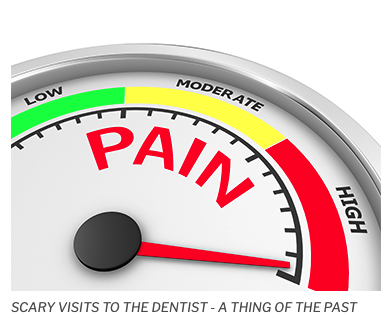
SCARY VISITS TO THE DENTIST – A THING OF THE PAST?
Many people have, at some point, feared or at least felt apprehensive about a visit to the dentist. The fear of discomfort or pain has always been a consideration, although attitudes have changed greatly as techniques, technology, and patient expectations have evolved.
The perception of failure in ourselves because we cannot consistently comply with treatment recommendations is a major issue too. Sometimes it can be every bit as significant as the fear of a dental procedure. Why would you commit to treatment that you do not believe you can successfully carry out?
CPAP is a perfect example.
So this becomes a very reasonable question: why would you?
Many, if not all, of these concerns require discussion and thought. You need to be comfortable that you are making the right decision because, ultimately, you always have a choice — even if that choice is to do nothing and accept the consequences.
It is true that many people will do things they would rather avoid because they recognise the benefit. Equally, with the stresses and competing demands of modern life, many simply will not. COVID-19 provided numerous examples of this, sometimes even among the world’s politicians.
FEAR
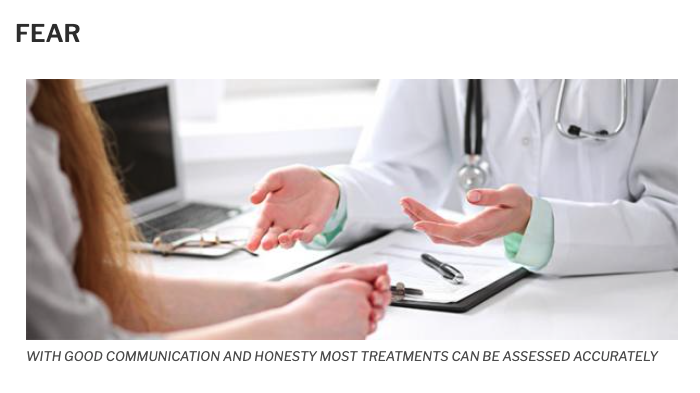
WITH GOOD COMMUNICATION AND HONESTY MOST TREATMENTS CAN BE ASSESSED ACCURATELY
Again, can you actually do what you are being asked to do? Will you do it? Is it going to work? Are you going to look back and see this as something worthwhile? What exactly is involved?
These are all fears and concerns that many people have voiced.
Such concerns need to be shared and answered honestly, without agenda or pressure. As a patient, it can be difficult to be open about your fears because doing so often makes you feel vulnerable. Let’s face it, healthcare is not what it used to be.
Dentistry is a business and, increasingly, medicine often feels like a system trying to fit patients into the services available. However, if you are to receive the care you actually want and need, rather than simply what someone else thinks you should have, it is worth the emotional discomfort of asking questions.
Once you have your clinician’s opinion, you can either ask the questions that matter to you or decide to proceed in one direction or another.
CHALLENGING THE RECOMMENDATION

WE NEED TO BE OUR OWN ADVOCATES – BUT TO KNOW OUR OWN LIMITATIONS TOO
Questioning the doctor? This was something that previous generations simply did not do. Today, for better or worse, people do it all the time. Many people have become sceptical. Big business seems to influence our decisions, our healthcare, and our money. Medicine is increasingly managed by administrators and accountants, while healthcare systems struggle under financial pressures. So, is this recommended treatment simply another example?
Everyone seems to have an agenda these days. They probably always did, but with modern communication we now see a much bigger picture, although not always the bigger picture.
Some people say, “I’m not a conspiracy theorist, but why shouldn’t I question these recommendations?” That is actually a reasonable question. In many situations, you probably should ask questions.
When CPAP is profitable and the number of companies offering services appears to increase every year, it is understandable that some people wonder whether sales tactics have entered healthcare. Equally, many people are surprised to learn that those responsible for regulating healthcare professionals are often not clinicians themselves and may have little appreciation of what day-to-day practice actually involves.
Some individuals will simply refuse advice regardless of its merit. If it was not their idea, it cannot possibly be right. Others will soften over time and choose to do something, hopefully before a significant health event forces the issue. Some will continue to resist despite mounting evidence. Human nature is remarkably varied.
Ultimately, however, people have the right to make their own decisions. With that right comes responsibility. We must accept that individuals are entitled to choose, even if we disagree with those choices.
The difficulty arises when those choices affect others. Seatbelt legislation is one example. Obstructive sleep apnea may be another. It is estimated that untreated sleep apnea is associated with a significantly increased risk of motor vehicle accidents, yet many people do not believe that statistic applies to them. Perhaps it does not. Then again, perhaps it affects someone else on the road.
Accepting treatment, or declining it, is a personal right. It becomes more complicated when our decisions have consequences that extend beyond ourselves.
DISTRUST
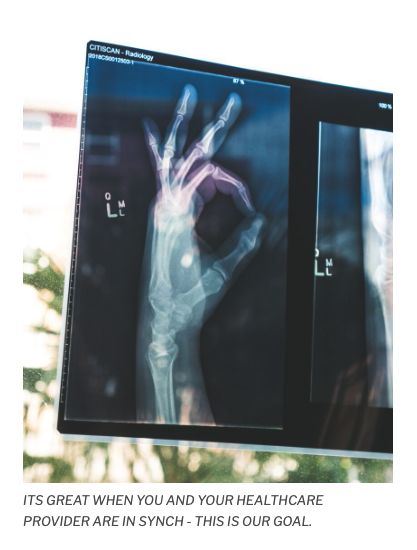
IT’S GREAT WHEN YOU AND YOUR HEALTHCARE PROVIDER ARE IN SYNCH – THAT SHOULD BE THE GOAL
“I don’t particularly like or trust the dentist or doctor.”
“They seem to have an agenda.”
“They don’t listen.”
“They don’t understand.”
“They are rude.”
These are comments I have heard many times over the years.
Why would you trust someone you do not like or respect?
The answer is simple: you probably shouldn’t.
If you genuinely do not trust your clinician, then finding someone with whom you feel comfortable may be one of the most important healthcare decisions you ever make. Your health is not something that should be entrusted to someone in whom you have no confidence.
However, do not deprive yourself of beneficial care simply because you dislike the individual presenting the recommendation. That is not fair on you. The recommendation may still be correct, even if the communication surrounding it leaves much to be desired.
You have every right to seek someone who can guide you through the journey of health improvement, maintenance, and ultimately wellbeing.
Health is not merely the absence of disease.
Of course, changing healthcare providers is not always easy. In many parts of Canada, and certainly here in British Columbia, people are often reminded how fortunate they are simply to have a family physician. Choice can be limited.
COVID-19 may have improved access in some respects through virtual consultations and alternative service models. Many of these innovations have been genuinely helpful.
Others require caution.
Not every provider is regulated. Not every service is independent. Not every recommendation is evidence-based. The growth of alternative therapies and commercial health services reflects both public demand and, in some cases, public dissatisfaction with conventional healthcare systems.
Some of these services are valuable. Some are not.
As with most things in life, the challenge becomes deciding whom to trust.
VALUE

THIS MAY BE THE MOST IMPORTANT CONSIDERATION OF ALL
If someone cannot see the benefit, why would they proceed?
On the other hand, during more than four decades in practice, I have repeatedly seen that when people genuinely understand and value the benefit they are seeking, there is very little that will stop them from achieving it.
OUR VALUE IN OURSELVES, OUR HEALTH, AND OUR TREATMENT IS PARAMOUNT
Determining Value
Determining value can be difficult. Whose value are we talking about anyway? Yours or your clinician’s?
The healthcare professional involved has an obligation to provide an honest assessment based upon the information available. Sometimes that assessment includes admitting uncertainty. Contrary to popular belief, clinicians do not always know the answer. Occasionally we do not even know what questions we should be asking.
Doctors and dentists make recommendations based on their knowledge, training, experience, and beliefs. Patients make decisions based on their own priorities, values, experiences, and goals. These are not always the same.
The answer for most people lies somewhere in between. Trust the recommendation enough to listen, but question it enough to understand. In many situations the best approach is to do a little of both.
Not everyone who has a condition requires treatment. Not every recommendation is urgent. Not every intervention is appropriate. However, when you genuinely understand the value of a treatment to your own health and quality of life, that understanding can carry you through almost any obstacle.
Those who see no value in the proposed treatment should pause before committing to it. Take time. Reflect. Ask questions. Seek additional information if necessary. The decision should be yours and yours alone.
One final point is consent.

Consent is both a patient’s right and a professional obligation. Patients should be informed of the available options, together with the risks, benefits, limitations, and alternatives of each. This is not simply good practice; it is a cornerstone of ethical healthcare.
Unfortunately, consent is not always provided as thoroughly as it should be. When that happens, the patient is disadvantaged and the clinician may place themselves at professional and medico-legal risk. Proper consent is not merely desirable; it is an important component of the standard of care.
I will finish with this thought. If you truly value the management of a problem that is affecting your health, wellbeing, or happiness, there is often very little that can stand in your way. Modern healthcare provides more options than ever before.
The key is ensuring that you have the information you need to make the decision that is right for you.